
CPCT Typing Test: Pattern, Speed & Free Practice
CPCT typing test guide: what CPCT is, the MP exam pattern, English & Hindi typing sections, the Mangal font, qualifying WPM, and free Inscript/Remington practice.
CPCT Typing Test Guide: Pattern, Speed & Free Practice
CPCT — the Computer Proficiency Certification Test — is the computer-skills exam administered by the Madhya Pradesh government (agency: MAP-IT) for recruitment to clerical and assistant-grade posts in MP state departments. A typing assessment is a core component. This guide explains the CPCT typing test pattern, the English and Hindi typing sections, the role of the Mangal font, and how to practise for free.
What is CPCT?
CPCT assesses the computer proficiency a candidate needs for MP government clerical roles. It is a computer-based exam held at designated centres, and its score is valid (typically two years) for recruitment to posts that require computer literacy — including data-entry, assistant, and clerk positions across MP departments. Candidates usually need to score above a set threshold on each section to be considered "CPCT certified."
CPCT typing test pattern
The exam includes separate typing assessments:
- English typing — standard QWERTY, passages to be retyped within a time limit.
- Hindi typing — Devanagari on a fixed layout; the modern standard is the Mangal (Unicode) font typed with the Inscript/Remington layout.
- Scoring in KDPH — speed is reported as key depressions per hour (and/or net WPM), with a penalty applied to errors to produce a net score.
- No backspace leniency — exam software penalises or blocks corrections, so first-time accuracy is essential.
Both typing sections are typically part of a larger CPCT paper that also covers familiarity with computer applications. The exact number of sections, time per section, and the minimum qualifying net score are defined in the official CPCT notification — confirm the current figures on the official CPCT portal (cpct.mp.gov.in) before you practise.
Qualifying WPM (English & Hindi)
CPCT measures typing in net KDPH / net WPM. Rather than memorise a single number, focus on two benchmarks:
- Reach a comfortable 30–35 WPM net in your chosen medium with 97%+ accuracy — this comfortably clears most clerical typing thresholds.
- Practise both mediums if your target posts accept either, and pick the one where your net (post-error) speed is higher.
The exact qualifying net KDPH/WPM for CPCT is set per notification and can change. Verify the current qualifying score and section timings on the official CPCT portal before the exam.
Mangal font for Hindi
For the Hindi typing section, CPCT uses Unicode (Mangal) Devanagari, typed with the Inscript keyboard layout (some candidates use the Remington mapping). Practical implications:
- Install Mangal and enable the Hindi (Inscript) keyboard in Windows Settings → Time & Language, so you practise on the exact font and layout.
- Do not practise on Kruti Dev if your notification specifies Mangal — the key mappings differ, and you'll build the wrong muscle memory.
- Drill the conjuncts (क्ष, त्र, ज्ञ, श्र, ह্ম) — these slow most candidates and decide the net score.
Free CPCT typing practice
- Match the exam conditions — fixed layout (no phonetic), disabled backspace, timer running.
- Practise both English and Hindi on exam-style passages.
- Track net WPM and accuracy every day; prioritise accuracy until you hold 97%+.
- Drill conjuncts for the Hindi section.
- Use learntype.app's free typing practice — the Hindi engine supports Inscript and Remington layouts on Devanagari, so you can train on the one your notification requires.
Frequently asked questions
What is CPCT? The Computer Proficiency Certification Test — Madhya Pradesh's computer-skills exam for state clerical and assistant-grade recruitment, including a typing assessment.
Does CPCT have Hindi typing? Yes — CPCT includes both English and Hindi typing sections; the Hindi section uses the Mangal (Unicode) font with the Inscript/Remington layout.
What is the qualifying typing speed for CPCT? CPCT reports net KDPH/WPM with an error penalty; the exact qualifying figure is set per notification. A safe target is 30–35 WPM net at 97%+ accuracy in your medium. Verify the current threshold on the official CPCT portal.
Mangal or Kruti Dev for CPCT? CPCT uses Mangal (Unicode) for Hindi. Practise Inscript/Remington on Mangal — not Kruti Dev — unless your notification states otherwise.
Related guides
- SSC Typing Test: Rules, Speed & Free Practice
- Hindi Typing Test: Free Online Practice (Mangal & Kruti Dev)
- Typing Test Exam Preparation Guide (India Government Jobs)
- Browse typing courses →
CPCT rules, section structure, and qualifying scores are published by MAP-IT per exam cycle. Always verify the current pattern and qualifying thresholds on the official CPCT portal (cpct.mp.gov.in) before practising or appearing.
Written by
Mohammad Ismail
Keep reading
More in Typing for Jobs
SSC Typing Test: Rules, Speed & Free Practice
Complete SSC typing test (DEST) guide: CHSL pattern, qualifying speed (35 WPM English / 30 WPM Hindi), error rules, Mangal vs Kruti Dev, and free SSC-style practice.
What Is Typewriting Practice? (And Why It Still Matters in 2026)
What typewriting practice means in 2026, why Indian students use the term, and the 3 most effective exercises for government exam typing preparation.
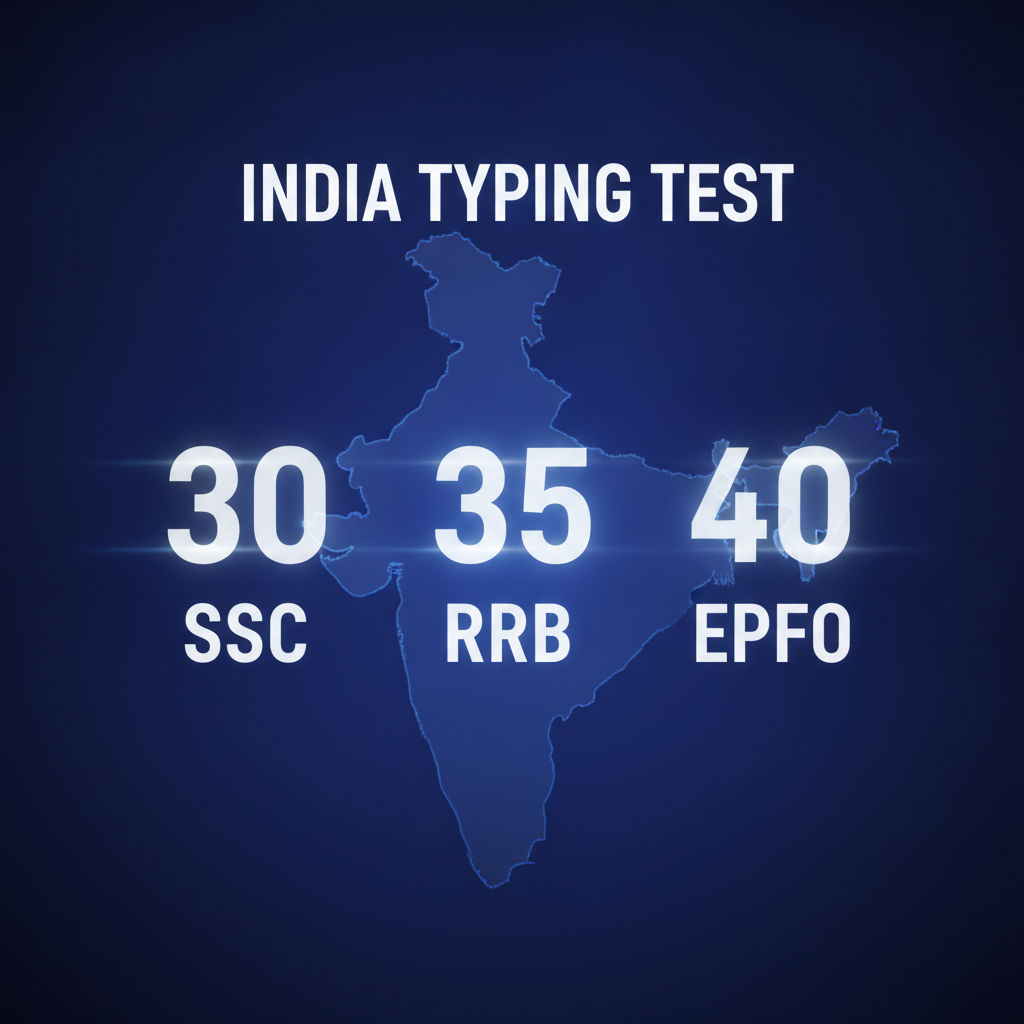
India Typing Test English — Practice for Government Exams
India government typing test requirements by exam — SSC, RRB, EPFO, KVS WPM thresholds, how to practice with backspace off, and the 4 techniques to clear the qualifying bar.