
Typing Practice Paragraphs — 50 Exercises for Beginners to Advanced
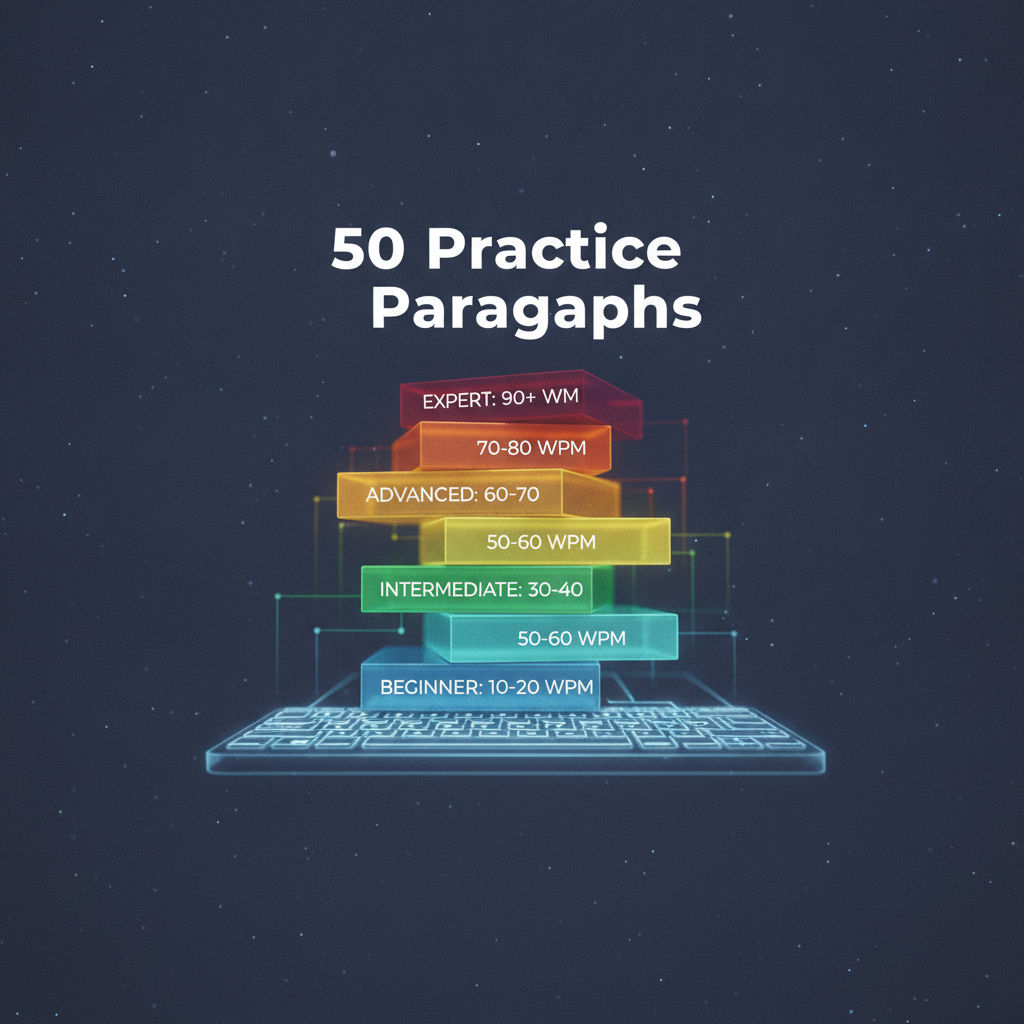
50 typing practice paragraphs from beginner (10 WPM) to expert (100+ WPM) — calibrated to specific speed ranges with instructions for measuring improvement per session.
How to Use These Practice Paragraphs
Each paragraph is calibrated to a WPM range. For each one: type it once to measure baseline, repeat five times focusing on accuracy, then measure again. Most typists improve 5–15% within a single session on familiar material.
Beginner Level (10–30 WPM)
Short sentences. High-frequency words. No complex punctuation.
1. The sun rose early. It was a bright morning. Birds sang in the trees. The air was cool and fresh. It was a good day to be alive.
2. She went to the store. She bought milk and bread. She also got some fruit. The total was not too much. She paid and went home.
3. He likes to play football. He plays every Saturday. His team has ten players. They win most of their games. He is proud of his team.
4. The dog ran fast. It saw a cat and chased it. The cat ran up a tree. The dog sat below and barked. The cat did not come down for a long time.
5. I wake up at seven. I eat breakfast at eight. I go to work at nine. I come home at six. I read for an hour before bed.
6. The school has five floors. Each floor has ten rooms. The rooms are big and clean. The teachers are kind and smart. Students love to go to school.
7. She writes letters to her friends. She sends them every week. Her friends are in other cities. They write back with their news. Letters make her feel close to them.
8. The market opens at eight. It sells fresh fish and vegetables. The prices are good on Tuesdays. Many people come in the morning. By noon, the best things are gone.
9. He works in a small office. He has three coworkers. They eat lunch together each day. They talk about work and life. It is a friendly place to work.
10. Rain fell all morning. The streets were wet and quiet. People stayed inside their homes. A few walked with umbrellas. The sky cleared in the afternoon.
Intermediate Level (30–60 WPM)
Longer sentences. More varied vocabulary. Natural punctuation.
11. Technology has changed the way people communicate. Emails replaced letters; messages replaced phone calls. The ability to type quickly and accurately is now as essential as handwriting once was. Those who invest in building proper typing technique gain a permanent productivity advantage across every digital task they perform.
12. The monsoon season in Bangladesh lasts from June to October. During this period, heavy rainfall causes flooding in low-lying areas, disrupts transportation, and challenges farmers who depend on the land for their livelihood. Yet the same rains refill rivers, recharge groundwater, and nourish the crops that feed millions of people.
13. Learning a second language as an adult is harder than as a child, but not impossible. Adults bring advantages children lack: larger vocabularies in their first language, stronger analytical skills, and clearer motivation. The key variable is time invested, not age. Those who practice daily for a year reliably reach conversational fluency regardless of when they started.
14. Dhaka is one of the most densely populated cities in the world. Its streets are busy at all hours, its markets are full of colour and sound, and its people are known for their resilience and entrepreneurial energy. The city has grown rapidly over the past three decades, driven by migration from rural areas and the expansion of the ready-made garment industry.
15. The science of habit formation reveals that most behaviours become automatic only after they have been repeated in the same context approximately 66 times — though this varies significantly between individuals and behaviours. For typing, the practical implication is clear: practise in the same environment, at the same time, using the same tools, and automaticity arrives faster than it does with varied, irregular practice.
Advanced Level (60–100 WPM)
Dense vocabulary. Complex structures. Sustained length.
16. The relationship between typing speed and professional productivity is nonlinear. Below 30 WPM, typing is a genuine bottleneck: thoughts form faster than they can be captured, interrupting cognitive flow and increasing the effort required to produce written work. Between 30 and 60 WPM, the constraint loosens gradually. Above 60 WPM, typing speed ceases to limit most knowledge workers, and the marginal return on further speed improvement narrows. The exception is roles where text production is the primary output — transcription, live captioning, court reporting — where every additional 10 WPM translates directly into throughput.
17. Bangladesh's digital economy has grown at remarkable speed since 2015. The country has established itself as a major exporter of IT services and freelance labour, with hundreds of thousands of young professionals earning foreign income from data entry, content writing, software development, and customer support. For this workforce, English and Bangla typing speed is not merely a credential — it is the core skill on which their income depends. Those who type at 50+ WPM in both languages command significantly higher rates than those who cannot.
18. The QWERTY keyboard layout, standardised in the 1870s for mechanical typewriters, has survived into the digital age largely through inertia rather than ergonomic merit. Alternative layouts like Dvorak and Colemak promise speed improvements of 5–15% for fully transitioned typists, but the retraining cost — typically 50–100 hours to return to previous speed — and the disadvantage of using unfamiliar keyboards in shared environments mean that QWERTY remains rational for most users. The layout debate is ultimately moot: technique and practice volume matter far more than key arrangement.
19. The physiology of typing speed reveals why short daily sessions outperform long irregular ones. Motor skills — including the finger movements that constitute typing — are consolidated primarily during sleep, when the cerebellum replays and strengthens patterns established during waking hours. A typist who practices for 20 focused minutes and then sleeps reinforces those patterns during eight hours of consolidation. A typist who practices for two hours once a week initiates consolidation only once, leaving the patterns to partially decay before the next session. The compounding effect of daily practice is real and significant.
20. Academic research on expert typing consistently finds that the difference between average typists and experts lies not in raw finger speed — physiological finger movement speed is similar across adults — but in anticipation. Expert typists read ahead, processing the next several words while their fingers handle the current one. This parallel processing means their fingers are never idle waiting for new input. Developing this anticipatory reading skill requires extended practice with complete sentences and passages, not isolated word or letter drills. It is the reason that paragraph practice is the final and most important stage of typing development.
Expert Level (100+ WPM)
Long-form technical and literary text. Sustained for 3–5 minutes.
21. The standardisation of Unicode Bengali encoding in the late 1990s represented a turning point for digital Bengali communication. Before Unicode, proprietary font encodings created a fragmented ecosystem where text produced in one software environment was often unreadable in another. A document typed in the Bijoy system's ASCII-based encoding could not be directly copied into a Unicode-compliant web browser without conversion. Unicode resolved this fragmentation by assigning permanent code points to every Bengali character, including all conjunct consonants, vowel signs, and diacritics — enabling Bengali text to flow seamlessly across operating systems, browsers, and applications. The transition from legacy encodings to Unicode is largely complete in Bangladesh, though legacy Bijoy documents remain in circulation in government archives, and many older typists still work in non-Unicode environments that require periodic conversion.
How to Measure Your Progress
After each session, record your WPM and accuracy. See How to Improve Your Typing Speed for the structured plan to move between levels. For Bangla-specific practice material: 200 Bengali Conjunct Practice Words.
Written by
Mohammad Ismail
Keep reading
More in Typing Tests & Practice
5-Minute Typing Speed Test — Challenge Yourself Daily
The 5-minute typing speed test — why it's the most accurate measure, what your score means for government exam eligibility, and a daily practice routine to improve it.

Typing Speed Test Bangla — How Fast Can You Type Bengali?
Test your Bangla typing speed, see how it compares to government exam requirements, and follow the step-by-step plan to push past the conjunct bottleneck.

English Typing Test Online — Practice & Improve Today
Take a free English typing test, see what WPM score is good for your level and career, and follow the 5-step improvement plan used by professional typists.